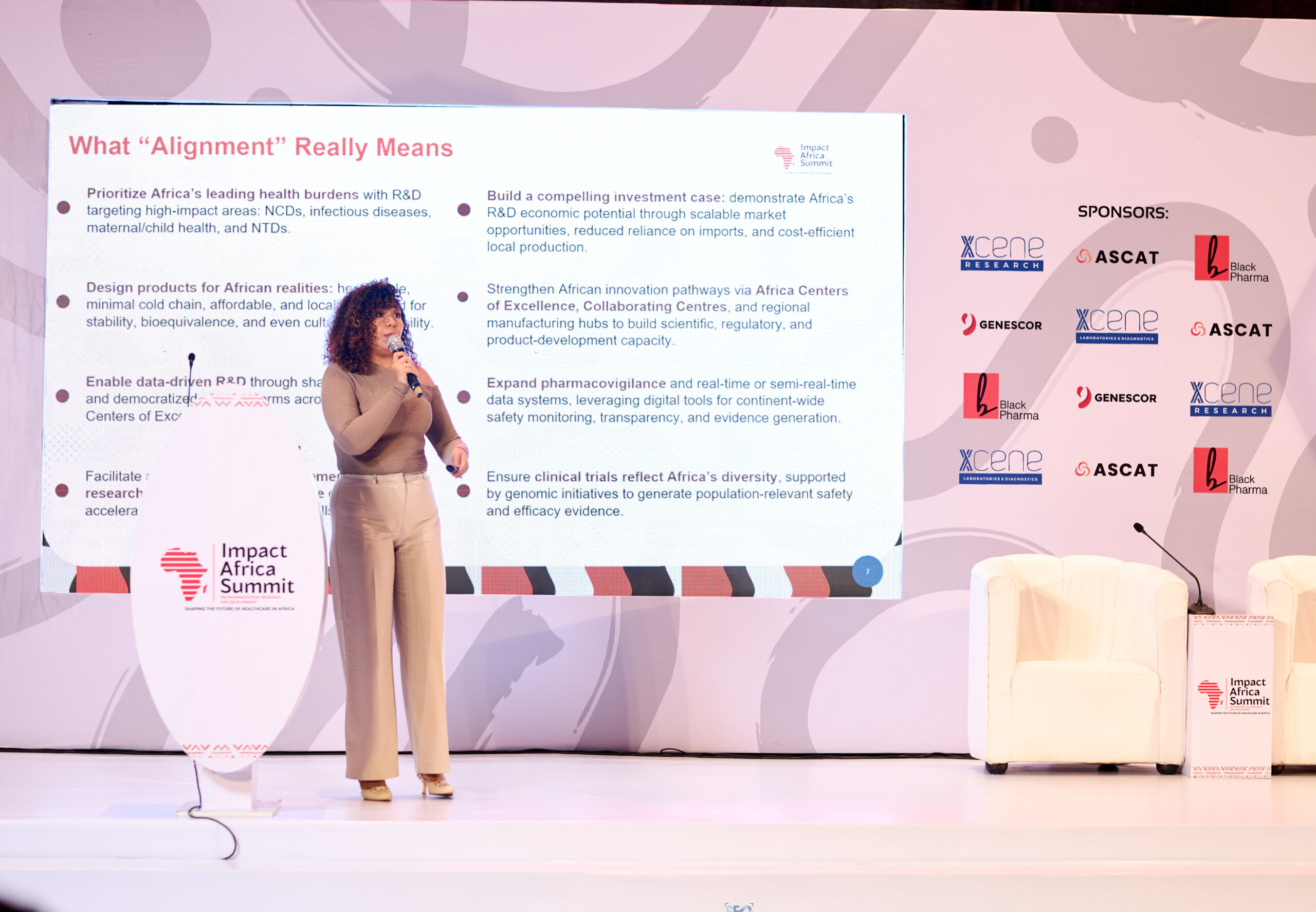
The Impact Africa Summit (IAS) 2025 provided a crucial platform to not only acknowledge the challenges facing the continent’s health sector but to forge a path toward African-led solutions. Dr. Mary Moussa, Head of Consulting at Africa Health Business and a Policy Fellow at the African Public Health Academy, delivered a compelling presentation that moved past the rhetoric of participation to issue a diagnosis and a treatment plan for Africa’s scientific destiny.
As part of our ‘Beyond the Summit’ series, we distill Dr. Moussa’s call to action: to transform Africa’s health priorities into Africa’s R&D agenda, ensuring innovation is driven by and tailored to the continent’s unique realities.
The Problem: A Triple Burden and a Two-Digit Gap
Dr. Moussa began with a powerful personal anecdote, highlighting the very issue the Summit seeks to address: a young medical doctor’s aspiration to develop a nanotechnology molecule stalled because “there was no lab, neither in East Africa or around in the region, where I can follow on with my production and testing.” This single story underscores a systemic flaw.
The continent is grappling with a triple disease burden:
- Infectious Diseases (like malaria, HIV, and TB).
- Non-communicable diseases (NCDs), where statistics are rising, posing a threat to economic development. For example, in Ghana, over 50% of deaths are attributed to NCDs, and in Algeria, this figure is over 70%.
- Neglected Tropical Diseases (NTDs), which are the continent’s reality, not global north negligence. For instance, 90% of the global schistosomiasis burden is within Africa.
Despite carrying this immense burden, Africa is profoundly underrepresented in global research. Only 3% of the global genomic database comes from people of African origin. Furthermore, while often quoted as having 2% to 5% representation in clinical trials, Dr. Moussa argues this is misleading: “If we take Egypt and South Africa of the equation, we are remaining with 0.3% maybe”. Over the past decade, 19 out of 54 African countries have not hosted a single industry-sponsored phase two to phase four clinical trial.
The Diagnosis: Donor-Driven Priorities and Fragmented Systems
Why is this the case? According to Dr. Moussa, the problem is twofold:
- Prioritization Mismatch: R&D investment is often donor-driven or focused on global health security concerns, rather than being a sovereign national decision prioritizing the actual disease burden of the continent.
- Structural Deficits: We are limited by underdeveloped local R&D capacity, insufficient infrastructure, inadequate funding, and fragmented regulatory systems. The sophisticated goal of precision medicine “seems far unless we start acting now”.
The Treatment Plan: A Roadmap for Scientific Sovereignty
The solution, Dr. Moussa stresses, requires a decisive shift toward African-led R&D:
- Prioritize Our Own Realities
- Design for Africa: Products must be heat stable, requiring minimal cold chains, and research must include bioequivalence studies and ensure cultural acceptability. Research is even needed on the impact of climate change on molecular stability.
- Focus on Our Diseases: We must focus on our unique disease burdens, such as sickle cell disease, and fund the research ourselves if it is not a global priority.
- Build Regional, Interoperable Ecosystems
- Centres of Excellence: Since we cannot have R&D centres in all 54 nations, we need to establish regional centres of excellence with strong collaboration.
- Data Democratization: Facilitate the sharing and interoperability of data to maximize limited resources and learning across the continent.
- Harmonization: Support initiatives like the African Medicines Agency (AMA) to harmonize policies and regulatory pathways, positioning Africa as an attractive, unified market for investment.
- Foster Respectful Partnerships
- Private Sector Leverage: Governments must leverage the resources, efficiencies, and experience of the private sector through respectful Public-Private Partnerships (PPPs) to develop centres of excellence.
- Community Inclusion: Clinical trials must not only reflect Africa’s genomic, age, and gender diversity but must place the respect of the community at the centre, informing, and sharing back information gathered.
The Outcome: A Resilient, Locally Driven Future
The anticipated outcome of implementing this plan is clear: enhanced research capacity, equitable representation of the African genome in trials, and a resilient, sustainable pharmaceutical sector aligned with the AU Vision 2063.
We must heed the wisdom of the Kenyan proverb that Dr. Moussa shared: “There is no one dawn that is like the other dawn in Africa”. Every day is a new opportunity. The time for the next African dawn in scientific leadership is now.